
James Esber
My Thing, Your Thing, and the Thing Itself
September 17 – October 24, 2026
PRESS:
Peter Schroth | Art Spiel
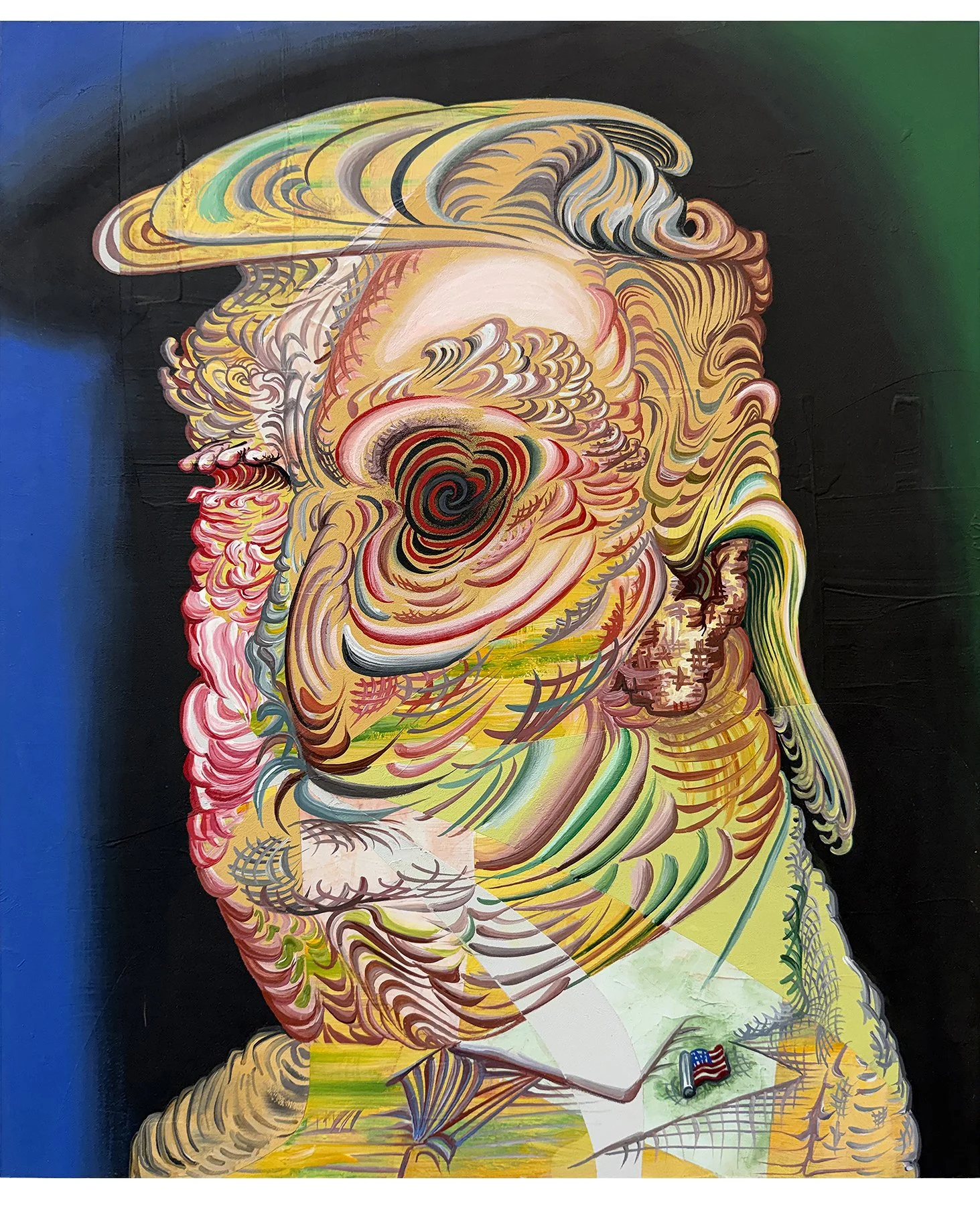
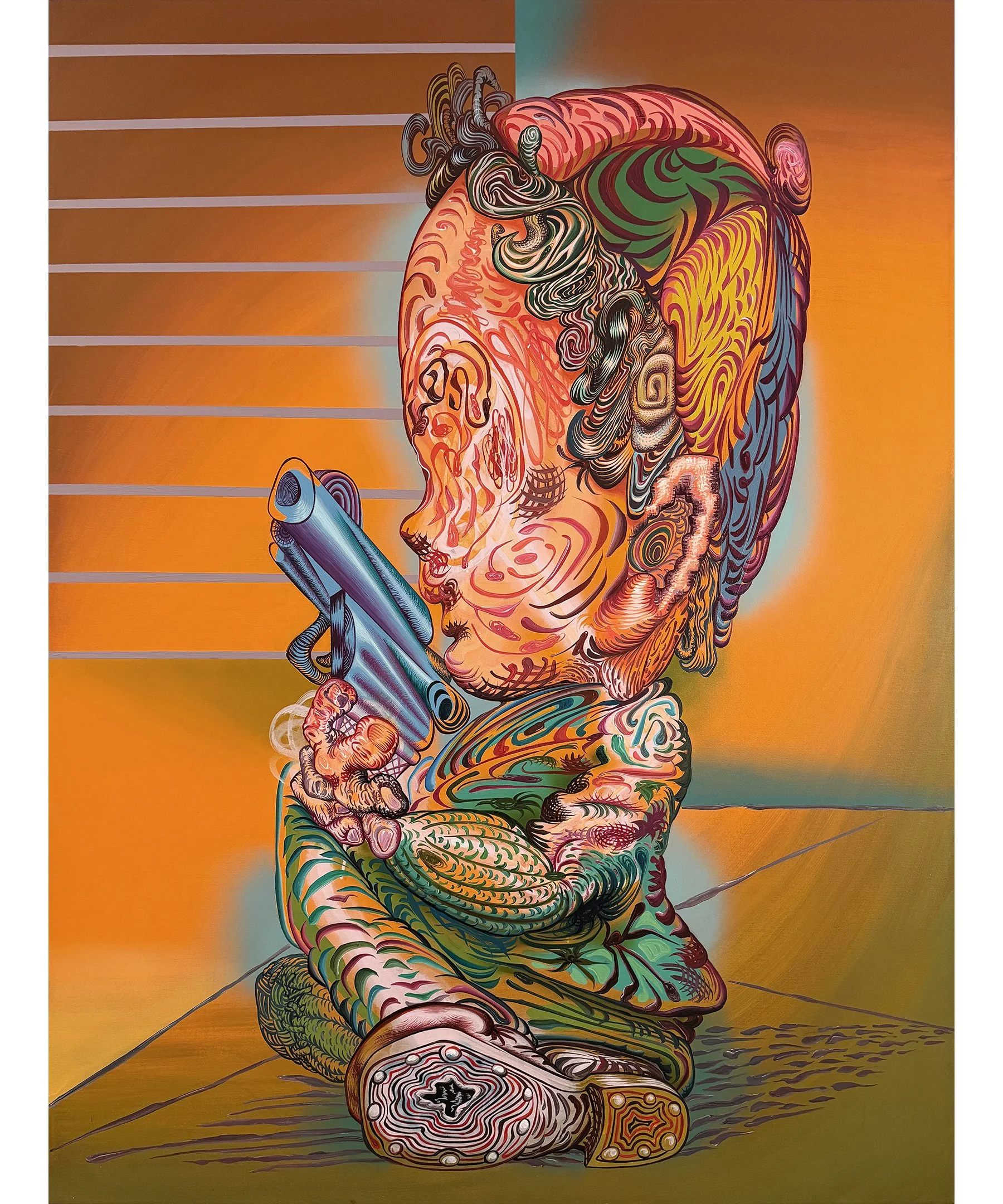
Satchel Projects is pleased to present My Thing, Your Thing, and the Thing Itself, a solo exhibition of recent paintings by James Esber, on view from September 17 – October 24, 2026. The gallery will host an opening reception for the artist on Thursday, September 17 from 6–8pm.
Known for his idiosyncratic image-making across a range of media, James Esber's recent work turns fully toward painting, pushing its language into stranger, more pungent territory. In the current works on view, he conjures distorted but legible figures and settings that are both type and archetype. Personal iconography mingles with the shared visual vocabulary of contemporary life, while political content surfaces in subtle and overt ways. Esber sources vivid and emotionally freighted images from the slipstream of contemporary and historical visual material that flows over and past all of us, using these images as the armature for painterly invention. Taking shape in the bewildered disorientation of our current moment, Esber’s paintings create a space and avatars for us to navigate and make sense (or nonsense) of it together.
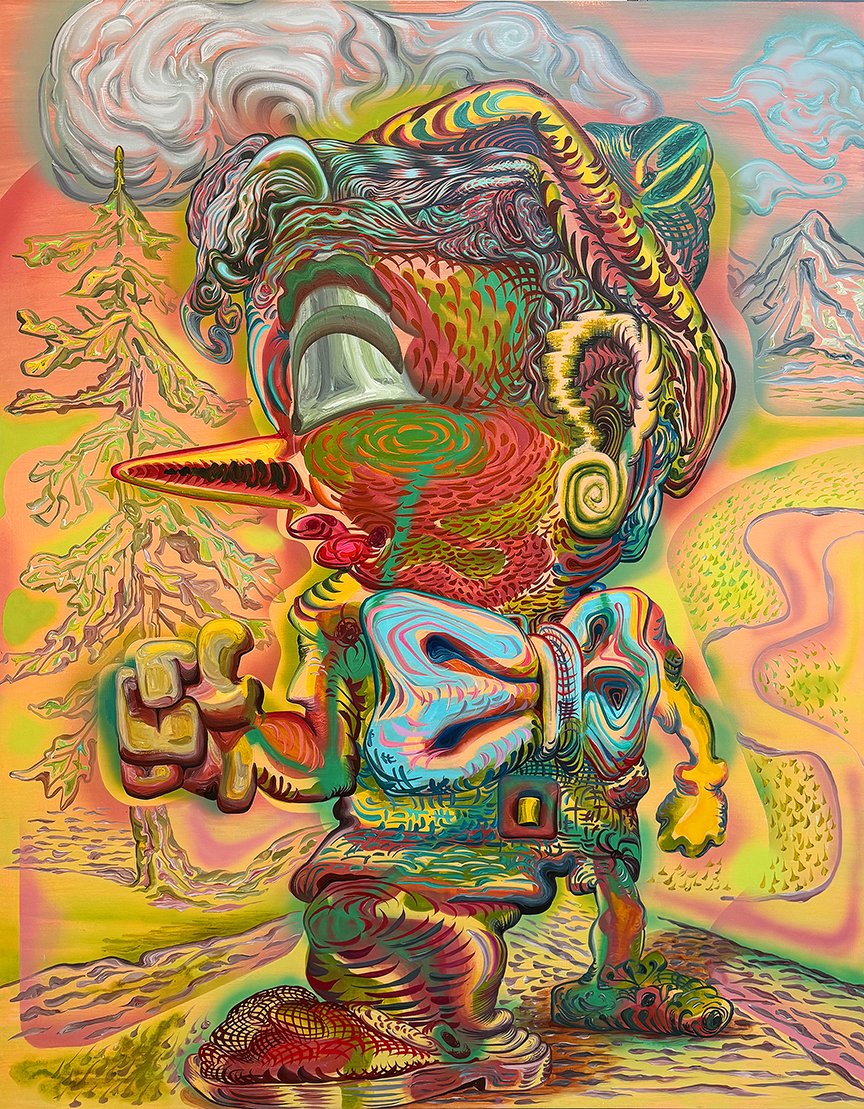
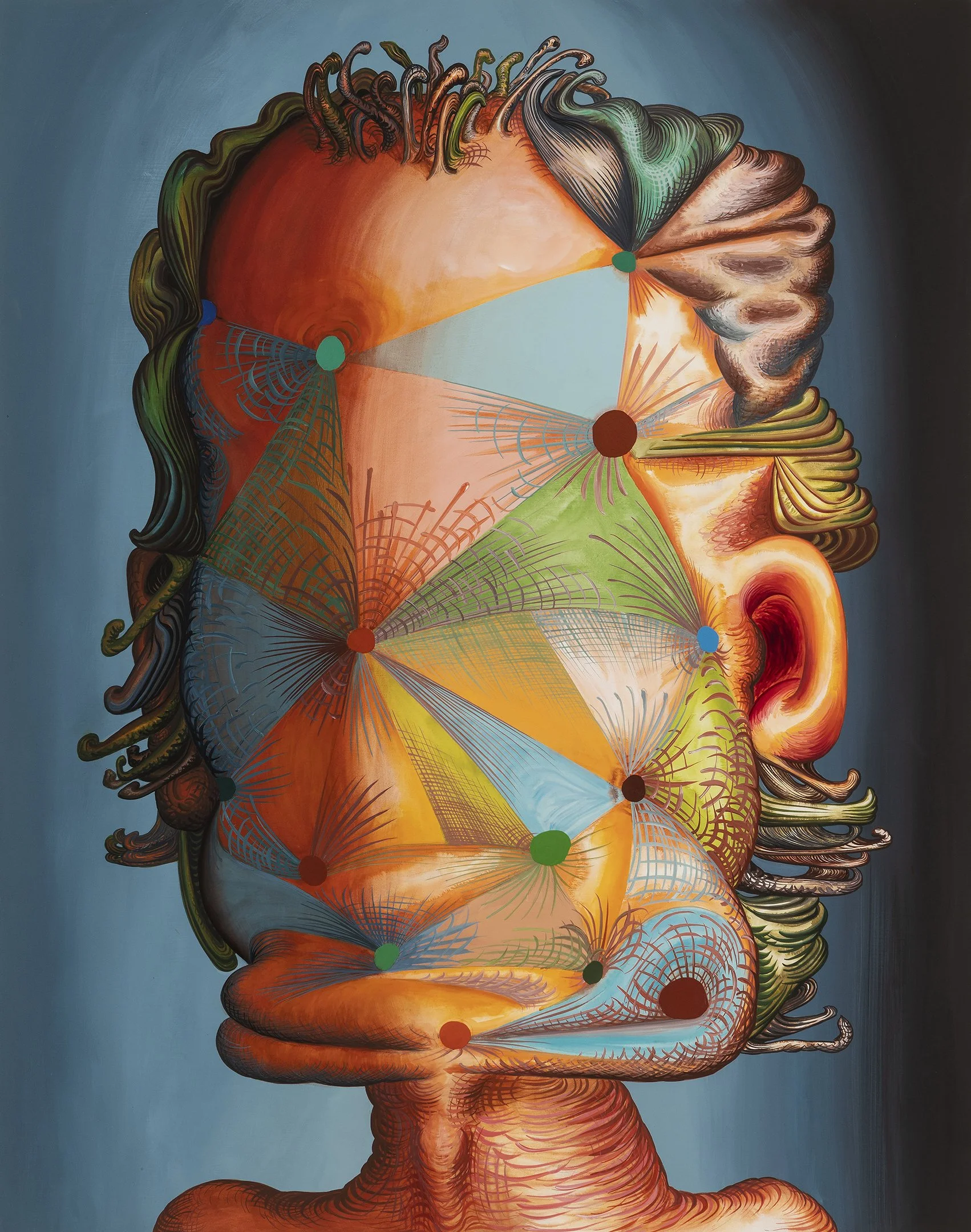
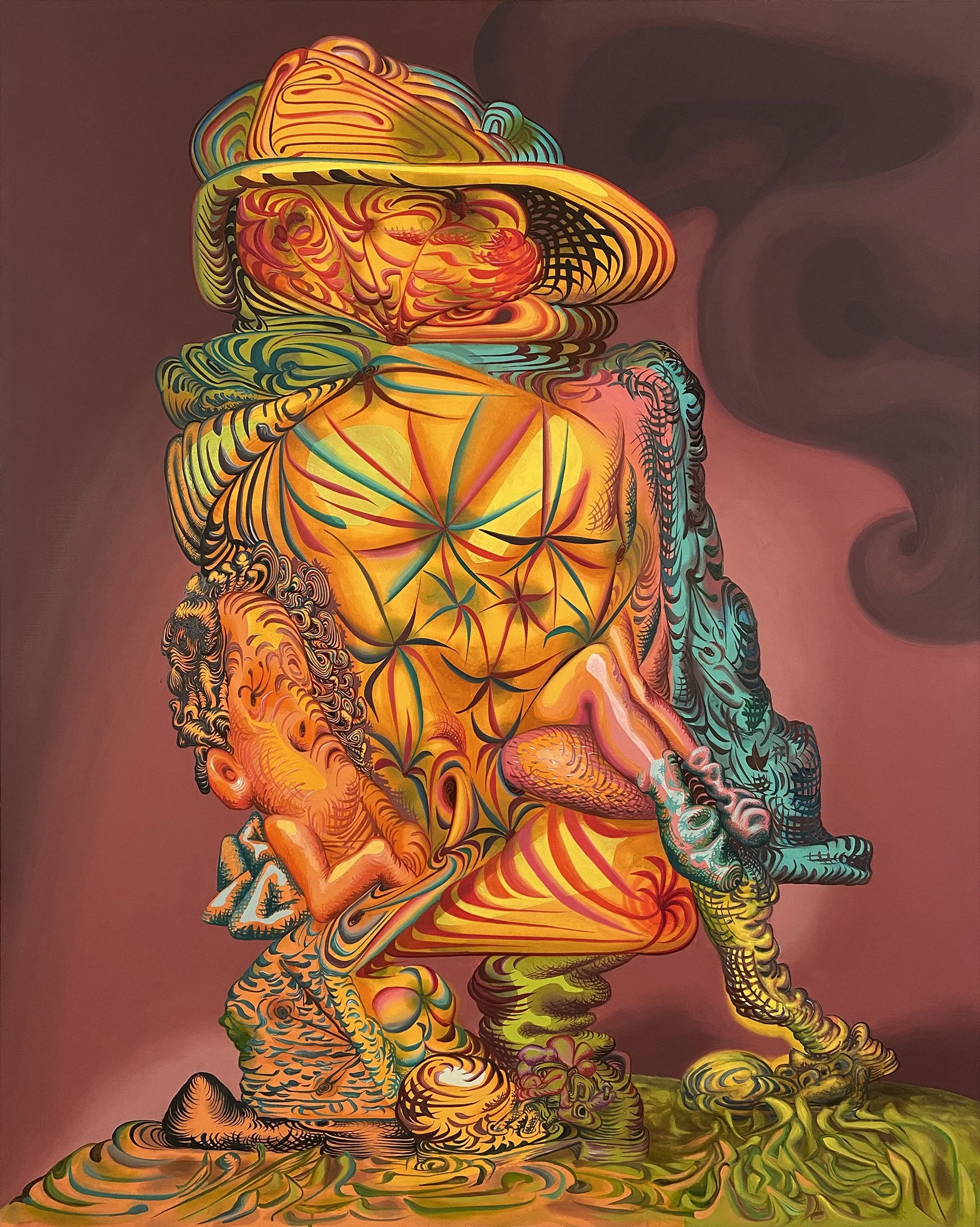
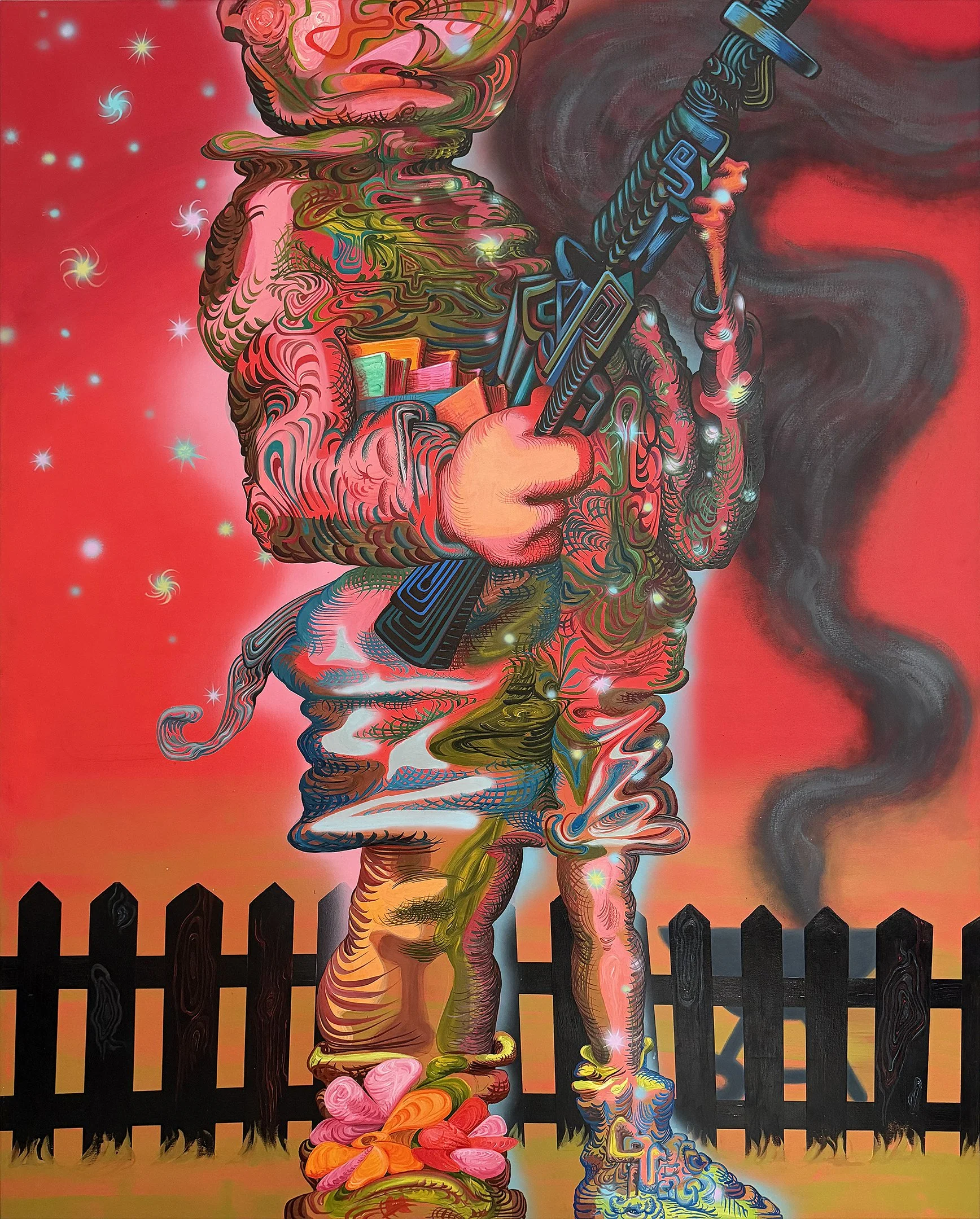
Using a painting language that is deeply informed by drawing, Esber creates tension through internal contradictions—humor and horror, the sentimental turned grotesque. These inner oppositions are reflected in formal contrasts: the graphic and visceral, the solid and diffuse. Esber deploys a vocabulary of glyphic marks that traverse and demarcate the figures and their environments. Repeated gestures, hatches, and contour lines animate the forms, crawling over the surfaces and imbuing them with energy and particularity. The marks are not simply descriptive; they simultaneously build up and undo the forms they delineate. At times, the figures seem to coalesce and dissolve, revealing the space behind them. Backgrounds are rarely stable or fully knowable. They can bleed into the permeable body, blurring the distinction between inside and outside.
Esber approaches color on its own terms, divorcing it from conventional expectations of representation. Descriptive marks and background interact to produce unexpected color relationships, rather than colors matched by saturation or naturalistic convention. His approach reflects a deep engagement with color perception, informed in part by the teachings of Josef Albers. The result is a color vocabulary that is both highly particular and integral to the construction of the image.
Tension between the recognizable and the distorted infuses the largest painting in the exhibition, titled Suburbia. Esber presents us with a male figure of outsized masculinity, too tall to be contained by the canvas, gripping a semiautomatic weapon while ominous smoke spills from a barbecue in the background. The figure’s right leg is grotesquely large, recalling Philip Guston’s drawings of Richard Nixon, in which bodily distortion becomes a vehicle for satirical comment. Another piece, True Lies, presents a Pinocchio figure posing against a tilted and restless Alpine background -- a liar with thumbs up. In this image, cognitive dissonance is carried by the visual and symbolic relationship between thumb and nose. In both works, familiar symbols are pushed into unsettling new configurations, while visual instability, malleability, and distortion speak to a provisional or contested notion of “truth.”
The most elegiac work in the exhibition, Rescue, depicts a firefighter carrying a child, slogging through a morass against a dark and smoky backdrop. At the time Esber made the painting, his father, a retired firefighter, was nearing the end of his life. A father himself, Esber is both the firefighter and the child, the parent and the son. The painting offers a different kind of masculinity from the figure in Suburbia: protective rather than threatening, embodying care and vulnerability. Its mixture of recognizable imagery and abstraction creates a productive discomfort.
At a moment when truth is increasingly up for grabs, Esber’s paintings ask us to consider how both images and meaning are constructed. Each painting arises from a subjective view of the world, shaped through selection, distortion, association, and invention, and completed through the viewer’s response. In this sense, My Thing, Your Thing, and the Thing Itself is as much about how we make sense of the world as it is about how we make — or look at — a painting.
James Esber (b. 1961, Cleveland, OH) has exhibited his work in New York City and beyond, including a 25-year survey at the Clifford Gallery at Colgate University (2014) and a solo exhibition at The Aldrich Contemporary Art Museum in Ridgefield, CT (2011). He has had solo shows at PPOW in NYC, Bernard Toale in Boston, and Pierogi in both New York and Leipzig. He has also shown widely in group exhibitions, including ASKEW at D.C. Moore Gallery (2022), Flex at the Tang Museum (2020), Now What? at the Norton Museum of Art (2011), The Land of Earthly Delights at the Laguna Art Museum, Laguna Beach, CA (2008), SITE Santa Fe’s Fifth International Biennial: Disparities and Deformations: Our Grotesque (curated by Robert Storr, 2004), New-Economy Painting at ACME Gallery, Los Angeles (2002) and Pop Surrealism at The Aldrich Contemporary Art Museum (1998). His work is held in the collections of the Norton Museum of Art, the Tang Museum at Skidmore College, The Flag Art Foundation and The West Collection, among others. His art has also been widely written about, including articles in The New York Times, New Yorker Magazine, BOMB Magazine, Juxtapoz, Art News, Hyperallergic and The Brooklyn Rail. Esber lives and works in Brooklyn, NY.